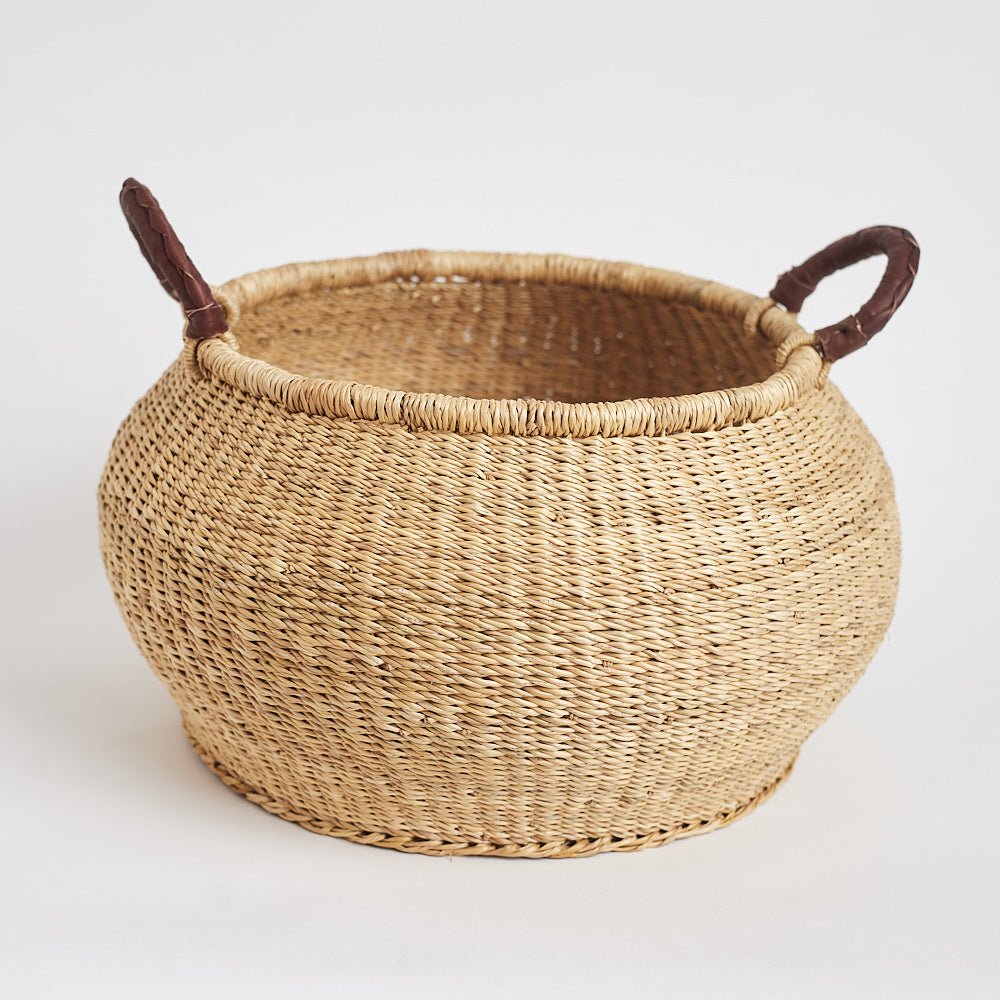
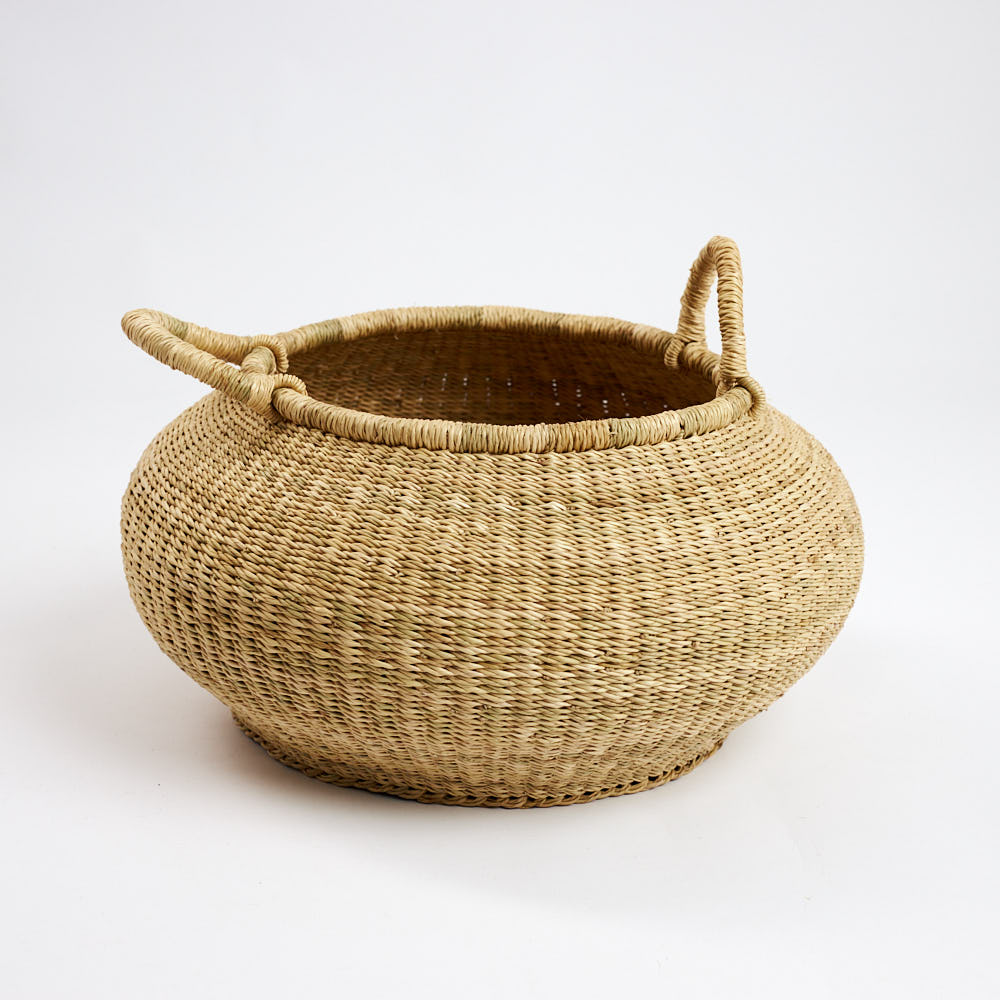
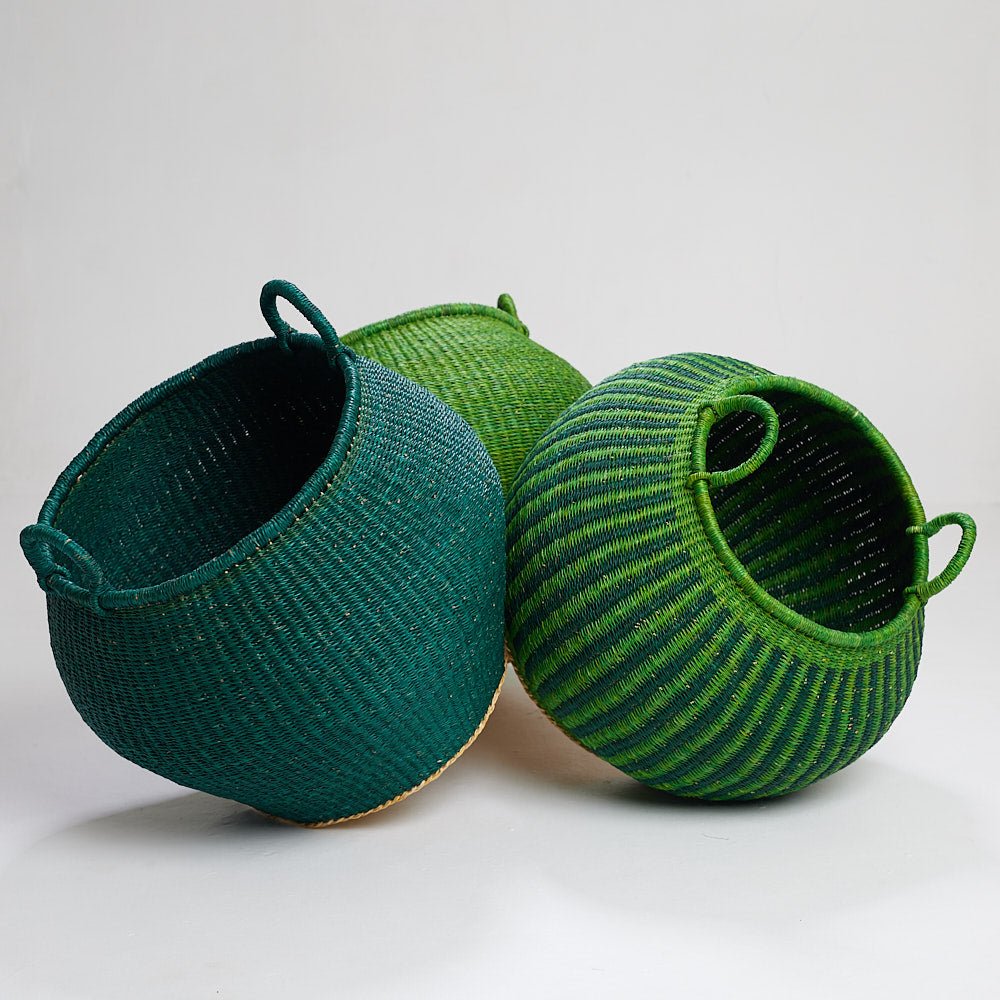
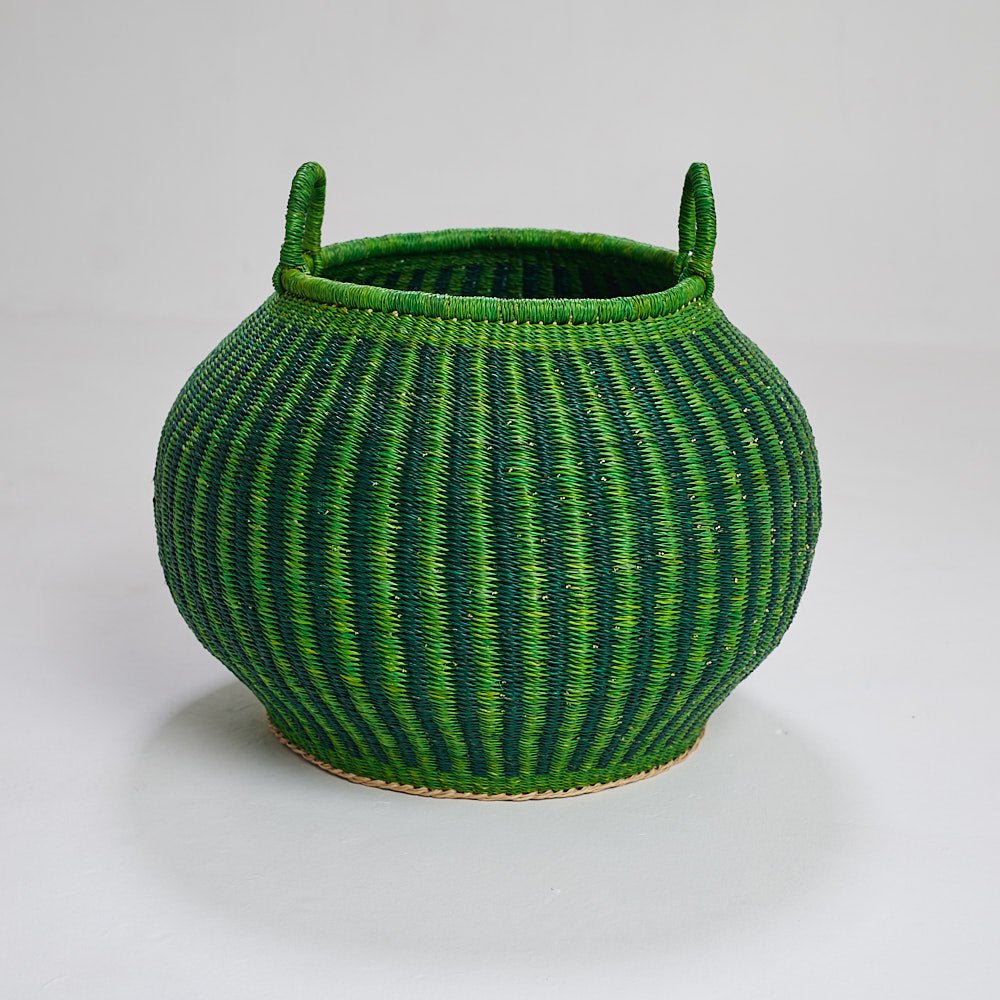
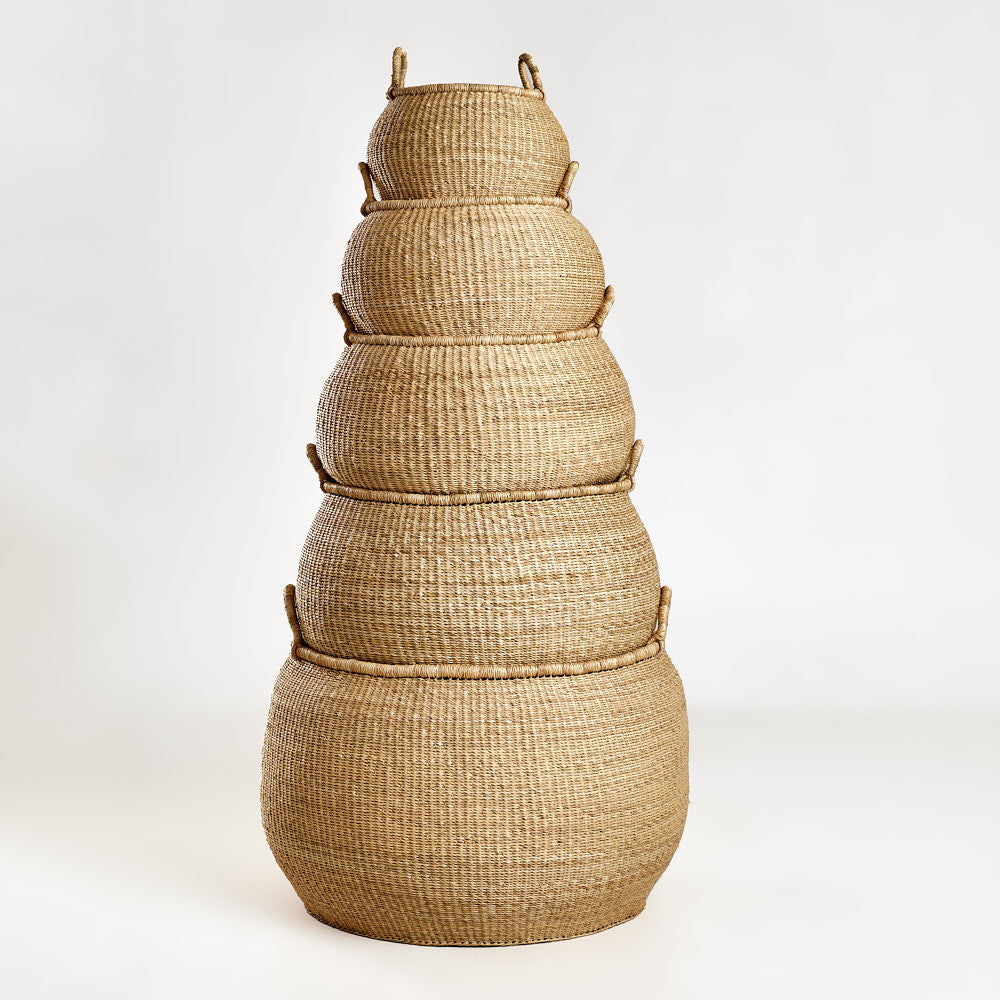
The Pot Basket, our signature form, is one of Woven Worldwide’s most technically demanding forms. Its rounded, generous ballooned body and wide base require steady and consistent tension throughout the weave, making it a basket that must be completed by a single artisan from start to finish.
Handcrafted in a countryside workshop in Ghana where baskets are produced by hand. Designed to hold its shape over time while remaining lightweight and functional, the Pot Basket is crafted using a single-weave technique over three working days and produced in limited quantities, where symmetry, balance and durability are non-negotiable.
Origin of the Design
The Pot Basket is shaped after the dadesan, a cast aluminum coal pot traditionally used for outdoor cooking. During early design development, the physical pot was brought into the workshop and used as a reference for proportion, balance, and base width. Inspired by our founder’s first encounter with her grandmother, Eva, this basket is a reference to the domestic tools and daily practices that shaped her understanding of usefulness and form.
At eight years old, she vividly remembers watching Grandmother Eva prepare porridge outdoors over a coal pot—a dadesan—with the earthy scent of smoke billowing in the air, mixed with roosters crowing in the background. Decades later, that simple coal pot—a vessel of nourishment and family togetherness, became the muse for Woven Worldwide’s product design team.
Building on this inspiration, the form was adapted to suit elephant grass.
Story Behind The Weave
When the design process began, we didn’t just bring sketches to the workshop, we brought the dadesan itself, the cast aluminum coal pot that inspired the Pot Basket. The artisans laughed when they saw it, amused that we’d gone to such lengths, yet their hands instinctively reached for it, weighing its heft, tracing its cool ridges.
We sat together on wooden benches, holding it close as the first Pot Basket took shape, its belly rounded and its base widened slightly from the original pot. Thompson was later brought on, and one afternoon, his younger brother Peter picked up Albert’s basket, eager to try. His interest was genuine, but we explained that baskets like this are the work of a single hand. Two weavers weaving the same piece can leave shifts in form and tension, the way two people writing on the same page can change the penmanship.
By the time we finished, the dadesan’s shape had found its way into the basket.
Materials with Meaning
Elephant grass is harvested by hand in the early morning under the same sun that ripens millet and shea trees, while the stalks still hold moisture. Once stripped of its outer husk, the inner reed’s pliable core is prepared to bend without breaking.
Elephant grass is a renewable and durable resource, growing in tall, bamboo-like clusters along the tropical banks of streams of living water in northern Ghana. One of its most notable qualities is its ability to thrive without the need for pesticides or fertilizers, making it an exceptionally sustainable crop.
Over time, the grass gradually transforms in colour, shifting from a soft pistachio green to an earthy ginger. It’s a raw material that speaks not only through colour, but through climate. This rain-fed transformation, shaped by the sun and passage of time, gives each reed its distinct character. While we call it elephant grass, it is more than raw material; it’s a harvest gathered patiently by hand.
From Field to Form
After preparation, the grass is bundled by farmers who understand how harvest timing affects fibre strength. The elephant grass is then sold to principal artisans who work through the early daylight hours, drying the bundles fully before any basket begins. This constraint slows production but ensures consistency and long-term durability. With our designs in hand, they prepare the material for the work ahead, splitting, rolling, and re-twisting each stalk for strength. During the weaving process, twisted reeds are submerged into clean water to soften, and then crafted into form by hand, using a single-weave method, with fingers toughened by repetition. The basket grows row by row, crafted upward and outward through hours of focused, deliberate work, until the rounded form takes shape, guided by the image of the dadesan. This is where every basket begins, not in our design studio, but in the countryside. This is beauty crafted, not in a rush, but according to the limits of material, labour and time.
These traditions echo the principles of sowing and reaping, and these decisions shape how the basket performs once it enters a home or interior space.
Why It Belongs
The Pot Basket is the kind of piece that settles into a home and stays. Its rounded, ballooned form can cradle firewood by the hearth, soften the corner of a living room with folded blankets, or keep vegetables within reach in the kitchen. In smaller spaces, it becomes a single, grounding object easy to lift and carry, yet large enough to hold the odds and ends.
The wide base gives it balance on uneven floors, the open mouth allows air to pass through stored linens or produce, and the curve of its sides recalls the steady warmth of the dadesan it was shaped after. Over time, this lightweight grass matures in tone, taking on the marks of the life around it.
It’s a vessel you don’t have to think about often, yet you notice it in the quiet moments when you set something inside, or when your hand brushes against its textured rim. That’s when you remember it was made start to finish by one person, in a place where baskets are still crafted to last.
Why It Is Priced This Way
The Pot Basket is priced according to the time, skill, and precision required to produce its rounded form. Each basket is woven by a single artisan using hand-prepared grass and completed within scheduled production cycles, then exported in planned container shipments. These constraints limit volume, but they ensure structural integrity, repeatability, and longevity.
Stewardship
Stewardship in the Pot Basket is visible in the hours required to shape the base, the care taken in material selection and preparation, and the precision demanded by the rounded base, along with the decision to prioritize consistency over speed. Each basket is tested for balance and durability before leaving the workshop.
Stewardship reflects respect for the resources given to us, and a deep appreciation for the skill and wisdom that have been passed down through generations.
For those who value stewardship, the Pot Basket serves as a visual and tangible reminder of the responsibility we hold to honour the resources we are given, to co-labour with the hands that shape them, and to create spaces that reflect gratitude.
Dimensions (inches)
Small 12 W x 10 H